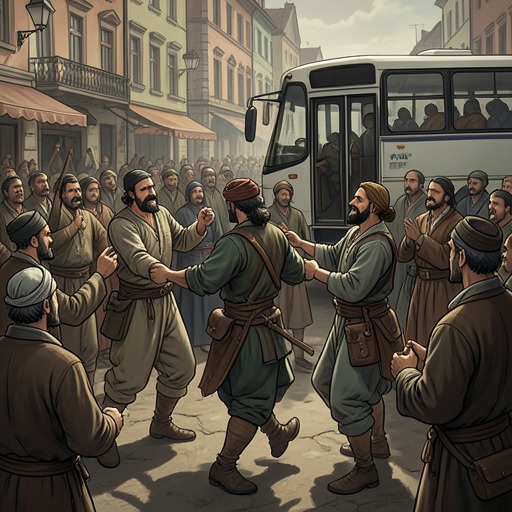
Karna
The God of Small ThingsKarna is the abandoned son of Surya and Kunti, a celebrated warrior raised in poverty who appears in the Kathakali performance Rahel watches. His defining scene joins recognition to an impossible choice: Kunti reveals herself as his mother and asks him to spare her other sons, while Karna’s old pledge to Duryodhana binds him to fight them. Through the performer’s worn body and the character’s divided loyalties, the episode makes a mythic hero’s fate feel intimate and painfully human.
Identity and Background
In the performance, Karna is presented through a series of identities that hold together uneasily: the radiant son of Surya, the abandoned child, the generous man, and the most revered warrior. Rahel watches him praying on the banks of the Ganga, still sheathed in his armor of light. The grandeur of that image is countered by the story of his origin: Kunti, unmarried after bearing him, placed him in a reed basket and cast him into a river. Adhirata, a charioteer, found the child downstream and named him Karna.
His abandonment is not merely background to his warrior status; it gives the mother-son encounter its emotional force. Karna has become a figure revered by others, yet the disclosure that his birth mother stands before him opens the old wound rather than closing it. His questions are immediate and physical: he asks where she was when he needed her, whether she held him or fed him, and whether she ever searched or wondered about him.
The Performance and Its Performer
The scene belongs to a Kathakali performance at the Ayemenem Temple, where Rahel watches the actors enact the story. The performer playing Karna is described as stoned, and his costume bears the visible marks of poverty and repeated use: a tattered skirt with darns, hollows in the crown where jewels once sat, a velvet blouse worn bald, and cracked heels. The discrepancy between the legendary warrior’s splendor and the actor’s depleted appearance makes the role’s vulnerability visible without erasing its majesty.
The actor performs for tourists at the History House, where the visitors’ imported attention spans and lolling nakedness provoke his rage. He checks that anger, dances for them, collects his fee, and gets drunk or smokes a joint. Later, he and the other performers stop at the Ayemenem Temple and dance to ask pardon of the gods. The commercial performance and the act of supplication coexist: the story is paid work, but it is also the vessel through which the actor gives shape to his own life.
The narration explicitly contrasts this performer’s struggle with an actor’s usual effort to enter a part. He strives to escape Karna, yet cannot do so. The character’s story acts as a safety net over despair, giving the performer color, light, structure, and containment. His poverty and defeat do not make the performance a simple spectacle of misery: in the account’s paradox, they are bound to his triumph in becoming Karna, abandoned and alone.
Recognition and the Mother-Son Encounter
Kunti comes to Karna while both performers are stoned. She is played by a man whose years in female roles have made his movements fluid and womanly. Red-eyed, she dances and tells him how a young woman used a secret mantra to summon a god, how Surya appeared, and how their son was born wearing a gold breastplate and earrings. The birth story gives Karna a lineage that his life as an abandoned child had withheld from him.
When Karna asks who Kunti is, she answers that she is his mother, standing before him. His response is an abrupt mixture of elation and anger. He demands the history of her absence, not simply the name of his father or the proof of his noble birth. Kunti answers his questions not with an explanation but by holding his painted face in her hands and kissing his brow. The kiss sends the warrior into an experience of infant-like tenderness: the narration describes him as a warrior reduced to infancy, shuddering with delight at his mother’s touch.
The scene’s tenderness does not undo the abandonment it exposes. The kiss gives Karna a moment of bodily closeness, while his unanswered questions preserve the distance between mother and son. Rahel watches the feeling pass through him, making the performance’s private emotional revelation legible to its witness.
Loyalty, Oath, and Tragic Choice
Kunti asks Karna to make a promise concerning the sons she has with Pandu. He cannot simply grant what she wants. The Pandavas, especially Arjuna, have publicly reviled him as the son of a lowly charioteer; Duryodhana rescued him by giving him a kingdom, and Karna pledged him eternal loyalty in return. His bond to Duryodhana therefore makes a complete promise to Kunti a betrayal of another promise.
Karna modifies what he can offer. He promises that Kunti will always have five sons: he will not harm Yudhishtra, Bhima will not die by his hand, and Nakula and Sahadeva will remain untouched by him. Arjuna is the exception. Karna refuses to promise his safety, declaring that he will kill Arjuna or be killed by him. The compromise honors his mother as far as he can while preserving the allegiance that governs his place in the coming war.
That oath turns the recognition scene toward foreknown loss. Karna can offer Kunti the assurance that she will retain five sons, but only because he and Arjuna are destined to decide between them through death. His generosity is real, yet it cannot reconcile the opposing loyalties or remove the violence ahead. The scene thus makes his virtue inseparable from his tragic predicament: even a promise shaped to spare his mother carries the prospect of a son dying.
Narrative Significance
Karna’s story appears inside the novel as a performed tale watched by Rahel, and its revelations are shadowed by the performer’s own circumstances. The legendary child cast away in a river and the impoverished actor performing him are not the same story, but the performance makes abandonment, poverty, and longing resonate across the two. The role does not offer the actor escape from his circumstances; it gives them a form in which he can continue to dance.
The encounter also places a large mythic story beside a particular act of recognition: a son asks his mother whether she ever held him, and she kisses him. That intimacy does not resolve the past. Nor does Karna’s generosity free him from his oath to Duryodhana. The performance leaves both attachments intact, so that love and loyalty become not solutions but the conditions of his impending conflict.
At the close of the episode, the air changes and Rahel knows Estha has come. The transition brings the performance’s story back into the twins’ immediate present. Karna’s divided family loyalties and the tenderness of a belated reunion therefore sound against the novel’s own concern with separation and return, without making the myth a simple parallel for the twins’ lives.